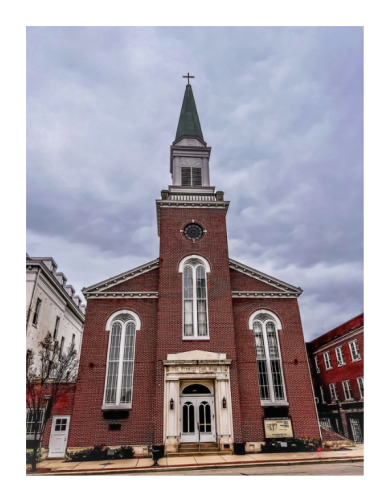
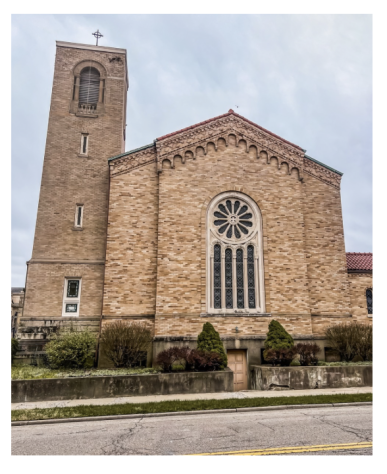
Our History: Two Congregations, One Church
For more than two centuries, Presbyterians have worshiped, served, taught, and helped shape the community of Hamilton, Ohio.
Today's Presbyterian Church of Hamilton was formed in 1984 through the union of two historic downtown congregations: Front Street Presbyterian Church on Front Street and First United Presbyterian Church on Court Street. Their stories developed along different branches of the Presbyterian tradition, but their histories were intertwined almost from the beginning.
Together, they give The Presby a history reaching back to the earliest years of Hamilton itself.
Presbyterian Beginnings in Hamilton
Hamilton began as Fort Hamilton in 1791. As the settlement grew into a permanent community, organized religious life soon followed.
Presbyterian ministers were preaching in the area during Hamilton’s early years, sometimes gathering worshipers in private homes, outdoors, and in the old military buildings of Fort Hamilton. In 1810, a Presbyterian congregation was formally organized under the leadership of the Rev. Matthew G. Wallace. This congregation became First Presbyterian Church and is the direct predecessor of the congregation historically associated with our Front Street Worship Center.
A second Presbyterian tradition soon took root in Hamilton. In 1816, settlers from the Associate Reformed Presbyterian tradition organized what would eventually become First United Presbyterian Church.
The two congregations were distinct, but they were neighbors from the beginning.
One Building, Two Congregations
Their early cooperation was remarkable.
In 1817 and 1818, the Presbyterian and Associate Reformed Presbyterian congregations joined together to erect a church on the east side of Third Street between High and Court Streets. The building measured approximately 40 by 50 feet, and the two congregations shared it, worshiping there on alternating Sundays.
Hamilton was still a small frontier community, and the arrangement reflected both necessity and cooperation. Nearly two centuries before the congregations officially united, Hamilton’s two Presbyterian families were already sharing a place of worship.
In 1829, the congregations established separate homes.
The Presbyterian congregation built a church at Front and Sycamore Streets. The Associate Reformed congregation moved to the southeast corner of what was then Basin Street and Water Street, today Court Street and South Monument Avenue, the location of our present Court Street Worship Center.
First Presbyterian Church
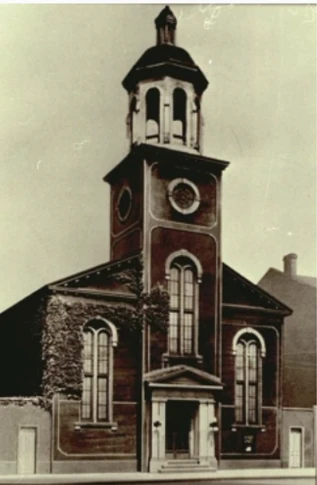
The congregation organized in 1810 called the Rev. Francis Monfort to Hamilton in 1821. Monfort served the church for sixteen years and became an important figure in the religious and educational life of early Hamilton.
His son, the Rev. Joseph Glass Monfort, briefly succeeded him in the Hamilton pastorate in 1837 before beginning a long and influential career in the Presbyterian Church. Joseph later became a prominent Presbyterian editor and church leader in Cincinnati. The Monfort family’s connections to Hamilton, Presbyterian publishing, education, and church leadership continued across several generations.
Front and Sycamore, 1829
In 1829, First Presbyterian left the shared Third Street church and erected its own building at Front and Sycamore Streets.
This was the congregation’s first separate church building after the years of shared worship with the Associate Reformed congregation.
The congregation remained there for approximately eight years. In 1837, the Front and Sycamore property was sold to a newly organized German congregation that later became associated with St. John’s.
First Presbyterian then moved northward on Front Street to the property opposite the Butler County Courthouse.
The Present Front Street Site
In 1838, the congregation erected a new brick church on the Front Street property opposite the courthouse.
This 1838 church is especially important to understanding our history. It was the First Presbyterian building standing during much of Hamilton’s antebellum period and during the years when the Underground Railroad was active in southwestern Ohio.
By 1854, however, the congregation was again pressed for room.
Under the pastorate of the Rev. Charles Sturdevant, the congregation began construction of what a nineteenth-century Hamilton history described as its fourth house of worship.
The new church was completed in 1855 on the same Front Street property.
An 1891 description of the building reported 98 pews, a gallery and organ loft, a sanctuary capable of seating approximately 500 people, and a large basement containing a lecture room, classrooms, the pastor’s study, and other church spaces.
That 1855 sanctuary became the historic core of the Front Street church known to generations of Hamilton Presbyterians.
The building has been altered, expanded, remodeled, and renovated over the generations, but the congregation’s presence on this Front Street property dates to the late 1830s.
The church’s pastors also connected Hamilton to important religious and social movements of the nineteenth century. Among them was the Rev. Adrian Aten, who served First Presbyterian Church in the early 1840s. Aten later became known as an outspoken antislavery minister. At Springdale, he helped establish a congregation intentionally opposed to slavery and was part of a wider network of Presbyterian ministers and laypeople engaged in the growing antislavery movement.
The Associate Reformed and United Presbyterian Tradition
Hamilton's second Presbyterian congregation was organized in 1816 in the Associate Reformed tradition, with roots among the many Scotch-Irish Presbyterians settling southwestern Ohio.
Some of the ministers and families connected with this tradition had already confronted the issue of slavery before coming to Ohio. The Rev. Alexander Porter, for example, was part of an Associate Reformed community that had migrated from South Carolina to Ohio in opposition to slavery and occasionally preached in Hamilton before the congregation received a settled pastor.
In 1817, the Rev. David McDill became the congregation's pastor. His ministry would connect Hamilton to a much larger story within American Presbyterianism.
In January 1829, McDill began editing The Christian Intelligencer, a religious periodical published in Hamilton for the Associate Reformed Synod of the West. Its pages addressed theology, church life, education, missions, and some of the most difficult moral questions facing the church.
Among them was slavery.
During a period when American churches were struggling with whether and how to confront human slavery, the Christian Intelligencer participated directly in that debate. Its publication in Hamilton places the city within an important early nineteenth-century Presbyterian conversation about slavery, Christian responsibility, and church membership.
The congregation continued to grow and, through later denominational changes and mergers, became known as First United Presbyterian Church.
The Court Street Church
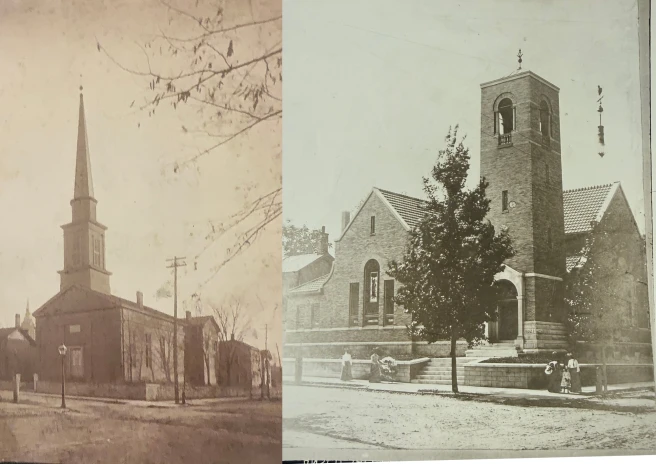
The United Presbyterian congregation eventually established its permanent home on Court Street.
The church building known by generations of Hamiltonians became one of the city's recognizable downtown landmarks. An early twentieth-century sanctuary was later devastated by fire, but the congregation rebuilt.
The bell tower survived.
When the church was reconstructed in the 1930s, the surviving tower was incorporated into the new building. It remains standing today as a physical connection between the present Court Street Worship Center and the earlier United Presbyterian church.
Through fires, floods, reconstruction, denominational changes, and generations of Hamilton families, the congregation remained part of downtown Hamilton.
Presbyterians, Slavery, and the Underground Railroad Era
The history of Hamilton's Presbyterian churches unfolded during one of the most divisive periods in American religious history.
Questions surrounding slavery divided congregations and denominations throughout the United States. They were not abstract questions in southwestern Ohio. Hamilton stood within a region crossed by freedom seekers escaping slavery and by the people who helped them.
Historical research now establishes Hamilton as a documented Underground Railroad way-station and routing point within a larger network connecting Cincinnati, Hamilton, West Elkton, Darrtown, Fairhaven, Indiana, and other communities.
The Presbyterian and Associate Reformed communities of Hamilton also had connections to ministers and families active in the wider antislavery movement.
Those histories deserve to be told carefully.
Evidence presently documents Hamilton's role in Underground Railroad routes and identifies individuals within the community who assisted freedom seekers. It also documents strong antislavery activity among some ministers and members of the wider Presbyterian network. Research continues into the relationships between these people, Hamilton's churches, and the locations used to shelter and assist freedom seekers.
What the evidence does not presently establish is that either the Front Street or Court Street church building itself served as an Underground Railroad station. We believe preserving that distinction is important as we continue to learn more about this chapter of our history.
Two Churches Become One
The twentieth century gradually brought the two Hamilton Presbyterian traditions back toward one another.
Their denominations merged in 1958, prompting both congregations to adopt new names. The United Presbyterian Church became Frist United Presbyterian Church, while the other church became Front Street Presbyterian Church.
On January 1, 1984, Front Street Presbyterian Church and First United Presbyterian Church officially became one congregation: The Presbyterian Church of Hamilton.
The union brought together two congregations whose histories had begun only six years apart and whose members had once shared the same church building more than 160 years earlier.
The new congregation retained both historic downtown properties.
Today they are known as our Front Street Worship Center and Court Street Worship Center, continuing the stories of the two congregations that created The Presby.
Still in the Heart of Hamilton
The buildings, neighborhoods, ministries, and even the city surrounding them have changed dramatically since Presbyterians first gathered for worship in early Hamilton.
The calling to serve has remained.
Generations before us built churches, taught children, cared for neighbors, debated difficult questions of faith and society, rebuilt after disasters, and adapted their ministries as Hamilton changed around them.
We inherit that history with gratitude, while recognizing that understanding our past is an ongoing process. Church records, historical newspapers, family papers, photographs, archives, and local histories continue to reveal new pieces of a story that is more than two centuries old.
Today, The Presbyterian Church of Hamilton remains committed to worshiping Christ and serving the community from the same downtown Hamilton where our story began.
Heart of Christ, in the heart of the city.
Our Historical Timeline
1791
Fort Hamilton is established.
1810
The congregation that becomes First Presbyterian Church is formally organized.
1816
Hamilton’s Associate Reformed Presbyterian congregation is organized.
1817-1818
The two congregations jointly construct a church on the east side of Third Street between High and Court Streets and share the building on alternating Sundays.
1821
The Rev. Francis Monfort begins his sixteen-year ministry in Hamilton.
1829
The two congregations establish separate church homes.
First Presbyterian builds a church at Front and Sycamore Streets.
The Associate Reformed congregation moves to Basin and Water Streets, now Court Street and South Monument Avenue, the site of today’s Court Street Worship Center.
The Rev. David McDill also begins editing The Christian Intelligencer in Hamilton for the Associate Reformed Synod of the West.
1837
First Presbyterian sells its Front and Sycamore property and prepares to move north on Front Street.
The Rev. Joseph Glass Monfort briefly succeeds his father in the First Presbyterian pastorate.
1838
First Presbyterian erects a new brick church on the Front Street property opposite the courthouse.
1841-1842
The Rev. Adrian Aten serves First Presbyterian Church before continuing a ministry closely associated with the antislavery movement.
1854-1855
Pressed for additional room, First Presbyterian constructs its fourth house of worship on the same Front Street property. The 1855 sanctuary becomes the historic core of the present Front Street Worship Center.
1902-1903
The United Presbyterian congregation constructs and dedicates a major new sanctuary on Court Street.
1913
The Great Flood devastates downtown Hamilton and severely damages the Court Street church property and surrounding neighborhood.
March 12, 1934
Fire destroys most of the Court Street church. The tower survives.
June 23, 1935
The rebuilt Court Street sanctuary is dedicated, incorporating the surviving historic tower.
1960s
The Court Street congregation undertakes a major Christian Education Building project, expanding the church campus for education, fellowship, and ministry.
1958
Major Presbyterian denominational consolidation creates the United Presbyterian Church in the U.S.A. Hamilton’s congregations become Front Street Presbyterian Church and First United Presbyterian Church.
1983
The Presbyterian Church (U.S.A.) is formed.
January 1, 1984
Front Street Presbyterian Church and First United Presbyterian Church unite to form The Presbyterian Church of Hamilton.
Today
The Presby continues its ministry from its historic Front Street and Court Street locations in downtown Hamilton.